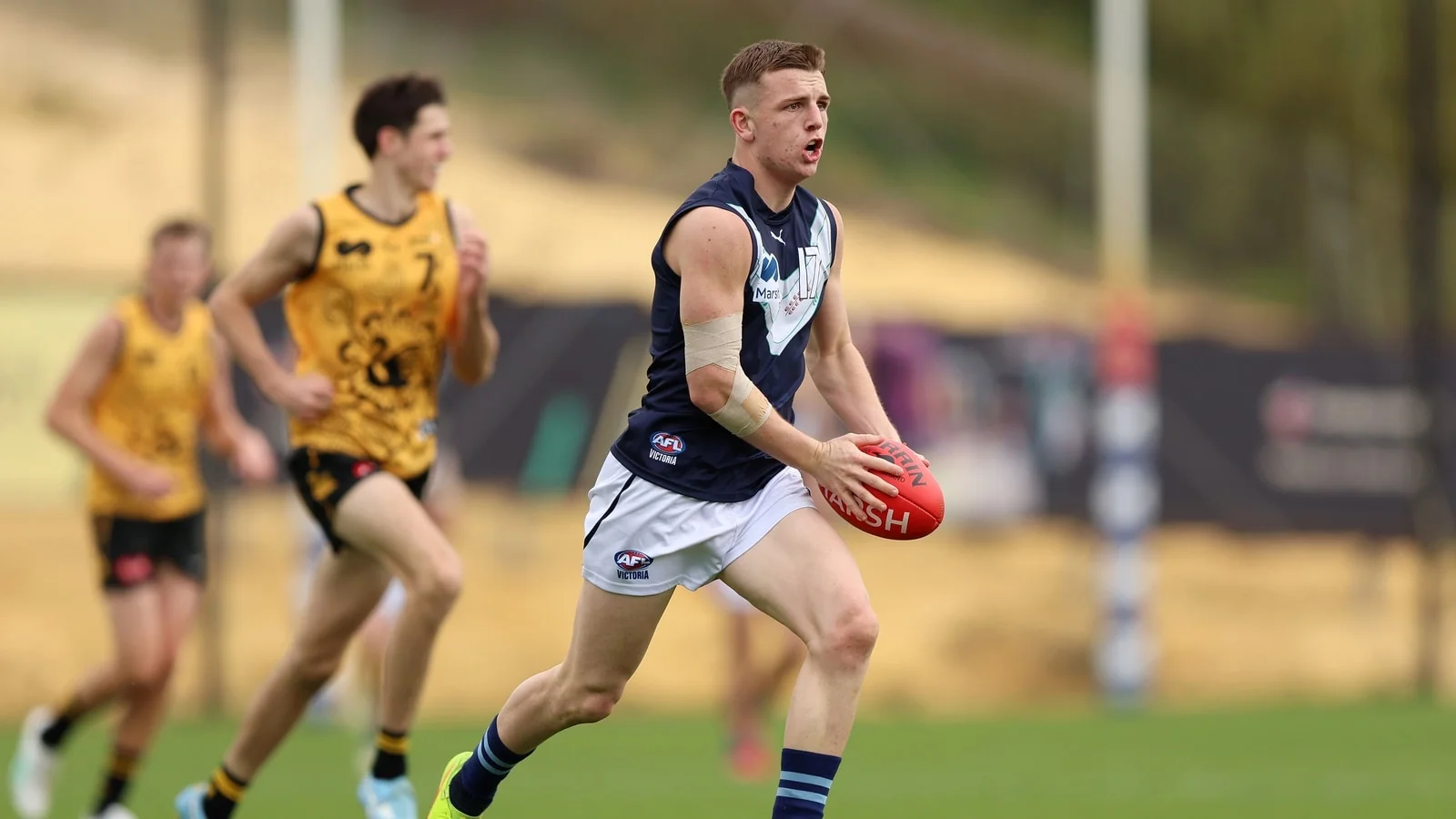
The 2026 AFL Draft brings together an unusually important set of early choices, club-linked prospects and list-building decisions. Use the confirmed dates and all 18 clubs' entry picks below, then look beyond the numbers to the roles each prospect offers and the different choices facing Essendon, Carlton, Collingwood and West Coast.
Put the three draft dates on the right clock
The 2026 national draft takes place across Thursday 19 November and Friday 20 November. Round one is on Thursday, with the remaining rounds on Friday; the pre-season and rookie drafts follow on Monday 23 November. The AFL's key dates put the rookie draft at 3pm AEDT on Monday. Keep that afternoon in the calendar as well as the two national-draft nights.
The first night is an in-person event at Marvel Stadium. The official viewing explainer lists Fox Footy on Kayo coverage from 7pm AEDT on both national-draft nights, with AFL.com.au and the AFL Live Official App's Draft Night Live analysis also starting at 7pm. Those are published coverage times; they do not promise the exact minute the first player will be selected.
| Date | Event | Published clock |
|---|---|---|
| Thursday 19 November | National draft, round one | Coverage from 7pm AEDT |
| Friday 20 November | National draft, remaining rounds | Coverage from 7pm AEDT |
| Monday 23 November | Pre-season and rookie draft day | Rookie draft: 3pm AEDT |
For viewers outside the south-east's daylight-saving clock, 7pm AEDT is 6pm in Brisbane, 6.30pm in Adelaide, 5.30pm in Darwin and 4pm in Perth on either national-draft night. The Monday rookie-draft time converts to 2pm in Brisbane, 2.30pm in Adelaide, 1.30pm in Darwin and noon in Perth. A Perth supporter finishing work needs a different viewing plan from someone following the same event in Melbourne.
The split across two nights also changes how to read an unfinished club haul. A club may have made its most prominent choice on Thursday while still holding important resources for Friday. Another may enter the event much later. Neither situation can be assessed fairly by comparing how many names each club has announced halfway through the process.
Leave room for the decisions that remain unresolved between sessions. Being overlooked in the national draft is different from having no possible route onto a list, while a rookie opportunity is still something a club must actually offer. For supporters, the useful habit is to record completed selections separately from possible next steps. That keeps a live discussion from turning an expectation into an announced outcome.
Every club's picks entering the national draft
Use the AFL's final order published on 11 November as the entry list. It supersedes the indicative order circulated after the trade period. The table includes all 18 clubs and every listed selection, with the first entry pick separated so supporters can quickly see where their club begins.
| Club | First pick | All entry picks |
|---|---|---|
| Adelaide | 15 | 15, 32, 35, 43, 54 |
| Brisbane | 21 | 21, 27, 28, 45 |
| Carlton | 13 | 13, 18, 31, 50, 59, 67, 73 |
| Collingwood | 11 | 11, 30, 63, 64, 65 |
| Essendon | 1 | 1, 17, 25, 69, 75, 78, 80 |
| Fremantle | 19 | 19, 40, 58, 61, 68 |
| Geelong | 36 | 36, 55, 60 |
| Gold Coast | 8 | 8, 70, 72, 77 |
| Greater Western Sydney | 9 | 9, 20, 26, 57 |
| Hawthorn | 29 | 29, 37, 66, 74 |
| Melbourne | 4 | 4, 14, 48, 51, 79 |
| North Melbourne | 33 | 33, 49, 62 |
| Port Adelaide | 7 | 7, 12, 22, 24, 34, 46 |
| Richmond | 2 | 2, 5, 44, 76 |
| St Kilda | 10 | 10, 16, 41 |
| Sydney | 6 | 6, 38, 39, 47 |
| West Coast | 3 | 3, 23, 56 |
| Western Bulldogs | 42 | 42, 52, 53, 71 |
The distribution creates very different viewing nights. Essendon can make an early decision and return at 17 and 25; the Bulldogs enter at 42. Carlton holds two first-round entries before a substantial gap, while Collingwood's 11 and 30 sit well ahead of its cluster in the sixties. A list of five or seven numbers therefore says little about the quality of the opportunities without their positions.
The 80 listed selections also do not promise 80 new national draftees. Clubs' usable selections are linked to list vacancies, and the order will be affected by subsequent decisions. Treat a club's haul as resources available to build a list, rather than assuming every entry will turn into a different player. That distinction becomes especially important when linked prospects attract bids.
Why an entry pick can move before a player is chosen
A matched bid can insert a selection ahead of another club and require the matching club to spend picks. Live trading can change who holds a selection. These mechanisms mean a supporter can correctly remember the entry number and still see a different number when the club finally chooses an available player. Track ownership and the decision being made alongside the screen's changing count.
The practical question is what remains available after each transaction. Two early entries are not necessarily two unrestricted choices if one is needed to secure a club-linked player. Equally, moving back can be part of an intentional exchange for another resource. The movement itself cannot establish whether a list manager has made a good deal.
Our 2026 bidding-rules guide explains the matching limits, loadings and conditional compensation in detail. Keep it beside the entry list when a bid occurs, rather than assuming a familiar calculation from a previous year still applies. This guide's club numbers describe the starting resources; actual bids, responses and trades will determine the route through them.
Read the leading prospects by role and access
Cal Twomey's November Phantom Form Guide ranks the strength of 30 prospects. Despite the name, it explicitly says it is not a Phantom Draft predicting the selection sequence. That distinction matters: a recruiting judgement about ability and a prediction about a club's next move answer different questions. Access, available picks and list priorities sit between them.
Cochrane and Walker bring different club connections
Dougie Cochrane is a 195cm prospect capable of playing forward or back, with marking and kicking central to his appeal. Kevin Sheehan's tall-player profiles identify his Port Adelaide Next Generation Academy access. His father Stuart played for Port and North Melbourne, but Cochrane does not qualify for either through the father-son rule. The connection needs its correct label before discussing a possible bid.
His interrupted season also requires care. Limited recent appearances leave a different evidence base from a player seen regularly throughout the year. That does not erase his earlier football, but it makes a confident claim about immediate senior output harder to support. Assess the role and the development plan alongside the excitement surrounding his name.
Cody Walker's access is father-son, through Andrew Walker's Carlton career. His football case is contested midfield work, reading stoppages and moving through congestion. The account of his draft year also describes sustained work within Carlton's training environment and an emphasis on improving his kicking. Familiarity with a club is useful preparation, but it should not turn every future role or selection decision into a foregone conclusion.
Drever, Butler and Mellody offer open-pool choices
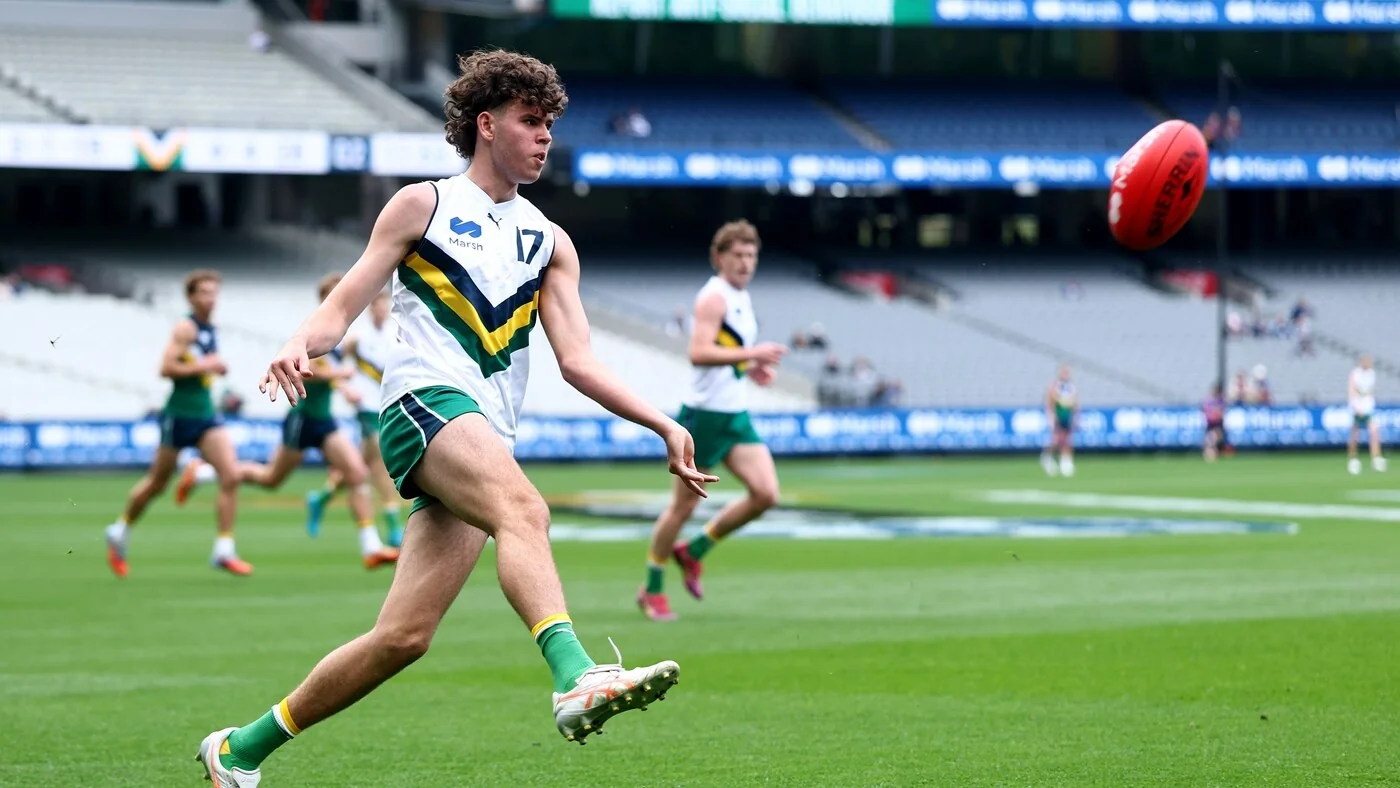
Ethan Drever brings burst from stoppage and an inside-outside midfield game. Sheehan's prospect profiles record his Victoria Country MVP campaign and GWV Rebels averages of 28 disposals and seven clearances in the Talent League. Those performances offer evidence of repeated involvement, while a 2.90-second 20-metre sprint adds a separate athletic measure. The sprint alone cannot show when he chooses to use that acceleration in a match.
Arki Butler presents a different proposition: a forward with goal sense, change of direction and the ability to create an opening around opponents. The small and medium forward profiles put his Sandringham Dragons output at 15 disposals and 1.4 goals across seven Talent League matches. For a club comparing him with a midfielder, the question is whether his forward-half influence supplies something its existing players lack. Raw disposal totals do not measure those jobs in the same way.
Heath Mellody's appeal includes midfield and half-back experience, ball use and senior state-league exposure. The midfielder profiles record his Larke Medal-winning championships, followed by six senior WAFL games for Claremont averaging 20 disposals. That gives recruiters evidence from another level, although six games remain a limited sample. Being a West Australian does not, by itself, reserve him for West Coast or Fremantle.
Tall prospects and later options widen the decision
Harry Van Hattum's 205cm ruck profile introduces a longer-term structural choice. His leap, competitiveness and work around stoppages give clubs more to examine than height alone. A club taking a young ruck must consider where he can gain meaningful football while developing the strength and craft required for the senior role. An early selection does not remove that development work.
Mitchell Harris offers a different tall-player skill set. Sheehan's defender profiles describe the 196cm Woodville-West Torrens prospect's intercept marking, one-on-one defending and progression into senior SANFL finals. Comparing Harris with a ruck or a forward is partly a decision about the role a list needs to develop. The same principle applies later in the draft: a specific, useful football skill can matter more to a club than a prospect's position on a general public ranking.
Four clubs face different list-building decisions
A useful club preview connects the draft hand to the list after completed player movements. The following needs are recruiting judgements based on that context. They describe choices to weigh, rather than announced selections or a claim that one teenager can solve an entire team's problems.
Essendon has the first call and more than one need
Essendon's trade-period wrap sets out a deliberate combination: Zach Merrett and Jordan Ridley departed, while Jack Bowes and Keidean Coleman arrived alongside extra draft resources. Bowes supplies experienced midfield support and Coleman adds ball use from half-back. Those additions give a young recruit people to learn alongside, without removing the need to develop another generation of players.
With entry picks one, 17 and 25, the Bombers can approach the night as a sequence of complementary decisions. A contested midfielder with acceleration could add a different layer to the group after Merrett's departure. A forward-half creator could instead provide a skill that is harder to acquire later. Drever's midfield profile and Butler's work near goal illustrate the distinction; neither comparison is an announcement that Essendon will choose that player.
The first decision also affects the later ones. If Essendon prioritises midfield talent early, its next opportunities can be assessed against what remains missing, including the development of marking options or defensive coverage. That is a more complete test than asking whether the first recruit resembles the departing captain. A replacement does not have to reproduce one established player's entire job immediately, and a rebuilding list still needs capable players across multiple lines.
Carlton must plan around Walker's price
Carlton's 13 and 18 require a different reading. The completed Lachie Whitfield trade preserved those first-round resources while bringing in Whitfield and selections 31 and 50. Walker's anticipated father-son bid is central to how the Blues can use the hand. Counting 13 and 18 as two unrestricted recruits, then adding Walker on top, would misrepresent the choices available.
Whitfield and fellow arrival Joel Amartey address established-player needs, but depth still matters. Hudson O'Keeffe and Flynn Riley have left, and Chris Davies had already identified ruck replacement options across the draft, trades and delisted free agency when discussing those possible departures. The practical question now is how Carlton balances cover behind its available rucks with a longer-term development project. Walker's midfield talent answers another question; it does not supply that tall-player depth.
For supporters, the useful second assessment comes after the match: what resources and list places remain, and what role can each remaining recruit reasonably fill? A young ruck may need substantial development before providing dependable senior cover. A more experienced option may help sooner but offer a different long-term upside. There is no need to decide in advance that one route is universally better; the relevant test is whether the resulting list has a workable plan for both timeframes.
Collingwood needs value beyond its first selection
Collingwood has already added Lachie Neale, Jesse Hogan and young ruck Flynn Riley, as its player-movement wrap confirms. Those additions change the draft discussion. Mature midfield and forward help can support an immediate campaign while creating space to develop younger talent, although an experienced recruit should not be treated as permanent cover for a role.
The entry hand of 11 and 30, followed by 63, 64 and 65, makes the first two choices particularly important. Twomey's current form guide links key forward Sam Gayfer with the Pies' first selection, while also noting interest from clubs ahead of them. That is reported interest, not a reservation. A young marking forward could develop alongside Hogan; a tall defender could address a different structural need. Availability and the club's judgement about development would determine which opportunity is actually better.
Pick 30 also deserves its own assessment. It is unlikely to offer exactly the same group available at 11, so a sensible plan needs more than one preferred name. A prospect with a clear transferable skill may complement the first choice even without the same public profile. The later selections should then be judged by the role and development pathway offered, rather than the assumption that a high number makes a player irrelevant. Getting one early call right does not complete the whole draft.
West Coast can balance immediate help with development
West Coast retained entry pick three while bringing in Trent Rivers and Jack Viney. The post-trade analysis identifies the experience and midfield support those recruits can provide. That gives the Eagles a bridge between present needs and developing talent. It should make the development environment part of the decision, rather than forcing the earliest draftee to carry every expectation immediately.
Mellody's ball use and midfield or half-back experience present one possible fit; Butler's forward-half craft presents another. The comparison is about the strongest football contribution the club believes it can develop, not simply whether a prospect comes from Western Australia. A player capable of helping sooner may still need time to establish an AFL role, while a longer-term selection requires an honest account of the opportunities available during that period.
There is also a resource decision beyond pick three. Twomey's reported trade approach involves pick 23 and West Coast's own future first-rounder in an attempt to acquire another early 2026 selection. The report says no deal had been locked in. If such a move happens, supporters should assess the extra player opportunity against the future asset surrendered. The eventual number attached to that future pick is still unknown; buying another early choice now is a genuine trade-off, rather than free acceleration of the rebuild.
Judge the draft as a set of decisions
Begin with the entry resources, then record what actually changes. When a club bids on a linked prospect, wait for the response before describing the player as secured. When a pick swap is discussed, distinguish an offer from an agreed transaction. Finally, look at the remaining picks and vacancies before declaring that a club has finished addressing its list.
That routine makes a draft-night judgement testable. If a club selects a midfielder early and a tall later, ask how the two roles complement the existing group. If it trades a future first-rounder, include that future opportunity in the cost. If two picks fund a match, assess the resulting player and the remaining opportunities together. A highlight clip can show an exciting skill without explaining the whole resource decision.
The same care should continue when a recruit begins training. A young ruck, a small forward and an experienced state-league player may face different pathways to senior selection. Early opportunity, physical development, available teammates and the role being taught all matter. A player appearing immediately is not automatically the better long-term choice, and a player developing outside the senior side has not automatically failed. The evaluation needs to follow what the club is asking him to learn.
Keep the football that follows within view through the Essendon, Carlton, Collingwood and West Coast fixture pages. Those pages help follow the clubs into 2027; they do not establish which draftees will make their senior teams. Selection and performance will provide new evidence after the recruiting decisions have been made.
Before attaching a final grade, return to the question that made each choice interesting: which role was needed, which player was available, and what did the club give up to secure him? The 11 November entry order provides the starting resources. The dates tell supporters when to follow the process. Prospect profiles explain the possible football contribution. The actual decisions, and the development work afterwards, will determine how well those pieces fit.
Join the conversation
Share a question or a thought about AFL. Comments are reviewed before they appear. Keep it friendly and on topic.
No comments yet. Start the conversation.
Sign in with Google to leave a comment. Your email address is not displayed.