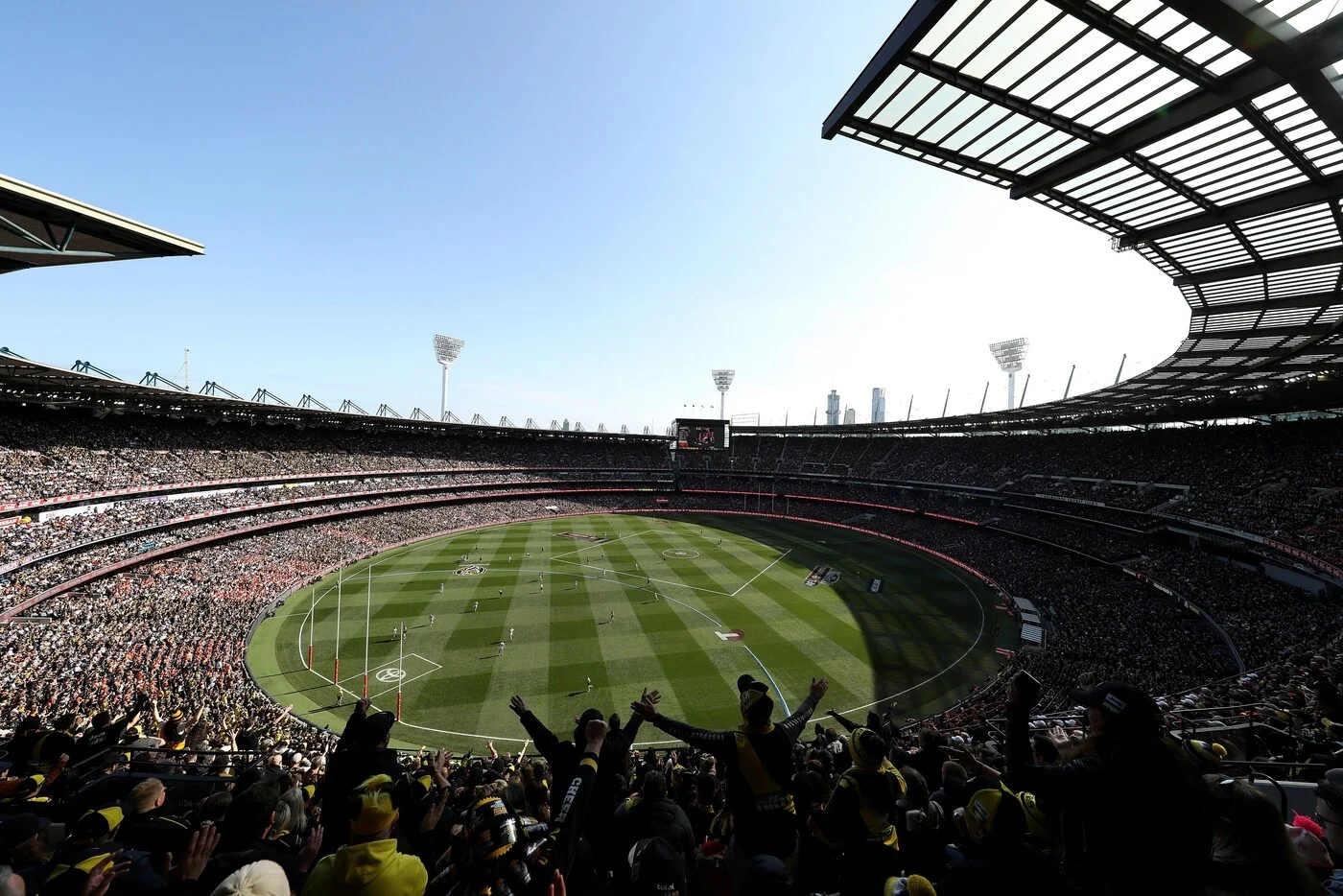
The AFL's club names carry state, city and suburban identities into a national competition. This guide groups the eighteen men's clubs by state, connects their nicknames and colours with their principal grounds, and explains the shared stadiums and travelling home fixtures that matter when choosing a match. Fixture examples follow the released 2027 season, checked on 15 November 2026.
The 18 AFL clubs by state and city
The men's AFL has 18 clubs: ten Victorian clubs and two each in South Australia, Western Australia, Queensland and New South Wales. Within Victoria, nine have Melbourne metropolitan identities and one represents Geelong. That concentration explains why a Melbourne fixture can involve two local clubs while a Queensland derby connects Brisbane and the Gold Coast, two different cities.
Use the table to identify the club, then locate its football home. The city column describes the geographical identity relevant to a supporter; it is not a list of administrative headquarters. Fremantle belongs within metropolitan Perth, and Port Adelaide within metropolitan Adelaide, but their names retain a more specific local identity than the wider city label alone conveys.
| State | Club | City / identity | Nickname | Core colours | Main home ground |
|---|---|---|---|---|---|
| Victoria | Carlton | Melbourne | Blues | Navy blue, white | MCG |
| Victoria | Collingwood | Melbourne | Magpies | Black, white | MCG |
| Victoria | Essendon | Melbourne | Bombers | Red, black | Marvel Stadium |
| Victoria | Geelong Cats | Geelong | Cats | Navy blue, white | GMHBA Stadium |
| Victoria | Hawthorn | Melbourne | Hawks | Brown, gold | MCG |
| Victoria | Melbourne | Melbourne | Demons | Navy blue, red | MCG |
| Victoria | North Melbourne | Melbourne | Kangaroos | Blue, white | Marvel Stadium |
| Victoria | Richmond | Melbourne | Tigers | Yellow, black | MCG |
| Victoria | St Kilda | Melbourne | Saints | Red, white, black | Marvel Stadium |
| Victoria | Western Bulldogs | Melbourne | Bulldogs | Blue, red, white | Marvel Stadium |
| South Australia | Adelaide Crows | Adelaide | Crows | Navy blue, red, gold | Adelaide Oval |
| South Australia | Port Adelaide | Adelaide — Port Adelaide | Power | Black, white, teal, silver | Adelaide Oval |
| Western Australia | Fremantle | Perth metro — Fremantle | Dockers | Purple, white | Optus Stadium |
| Western Australia | West Coast Eagles | Perth | Eagles | Blue, gold | Optus Stadium |
| Queensland | Brisbane Lions | Brisbane | Lions | Maroon, blue, gold | Gabba |
| Queensland | Gold Coast SUNS | Gold Coast | Suns | Red, gold, blue, pink | People First Stadium |
| New South Wales | GWS GIANTS | Greater Western Sydney | Giants | Orange, charcoal, white | ENGIE Stadium |
| New South Wales | Sydney Swans | Sydney | Swans | Red, white | SCG |
This is the 18-club men's competition entering 2027, checked against the AFL's official fixture statement. The familiar colours are a recognition guide, informed by the league's official club illustrations and club histories. They describe the club's core identity rather than every colour appearing on every playing strip, sponsor logo or commemorative design.
Read the home-ground column as a starting point
Here, “main” means the venue allocated the largest number of that club's designated home games in the released 2027 regular-season fixture. It does not mean an exclusive stadium, a privately owned ground or a guarantee that the next home match will be played there. Carlton, for example, has home fixtures at both the MCG and Marvel Stadium; Geelong's principal ground is GMHBA Stadium even though the Cats also host a match at the MCG.
The AFL venue directory makes the physical distinctions clearer. The MCG is in Jolimont, Marvel is in Docklands, the SCG is at Moore Park and ENGIE Stadium is at Sydney Olympic Park. A metropolitan name narrows the search without identifying the correct entrance, transport stop or part of town.
Count clubs separately from grounds. Adelaide Oval appears twice because Adelaide and Port Adelaide both use it. Optus Stadium appears twice because West Coast and Fremantle both use it. Conversely, a club appearing once in the table can take its home schedule to several venues. These two relationships explain much of the apparent mismatch between an AFL club map and a season's list of stadiums.
Victoria's ten clubs are not ten Melbourne teams
Calling all ten Victorian clubs “Melbourne teams” removes an important distinction. Geelong represents a separate city. The other nine form Melbourne's metropolitan group: Carlton, Collingwood, Essendon, Hawthorn, Melbourne, North Melbourne, Richmond, St Kilda and the Western Bulldogs. Within that group, the names describe different local associations even when the teams meet at the same central stadium.
Carlton illustrates the difference between a traditional home and a current men's match venue. The league describes IKON Park, or Princes Park, as Carlton's traditional home, in Carlton North. That connection helps explain the club's place in Melbourne. It does not move a 2027 Carlton men's home fixture from the MCG or Marvel Stadium to Princes Park. A heritage visit and a ticketed AFL match can require different destinations.
Essendon adds a third location to the equation. Its current club contact page lists its physical address at Melbourne Airport and gives separate directions for the NEC Hangar and Windy Hill. Neither address should replace Marvel Stadium or the MCG when those grounds appear on a men's match ticket. “Essendon” can identify the team, its historical locality or a transport destination; the surrounding context matters.
The Western Bulldogs' broader name is geographical too. The club describes Melbourne's west as its heartland, while its official documents retain Footscray Football Club Limited as the entity trading as the Western Bulldogs. That explains why Footscray remains part of the conversation without making Footscray a nineteenth AFL club. It also shows why a shared ground at Docklands cannot, by itself, describe the whole community a club represents.
Geelong has a city identity of its own
For the Cats, club identity and the principal stadium align more directly. Their official location is GMHBA Stadium at Kardinia Park in Geelong, and the venue is central to the city's football experience. A Geelong home match at the MCG remains a Cats home fixture; it does not turn Geelong into a Melbourne suburb or make the two grounds interchangeable.
That distinction changes an itinerary. The Kardinia Park Stadium Trust describes Geelong as 75 kilometres from Melbourne and gives an approximate one-hour rail journey from Southern Cross. South Geelong station is around 450 metres from the stadium, whereas Geelong station is farther away. Those details are useful starting points, with the actual service and event arrangements still to check.
A visitor choosing between a Cats game in Geelong and one at the MCG is therefore choosing between two different match-day settings. The former can combine a regional city visit with football; the latter fits a Melbourne stadium itinerary. Selecting “Victoria” on a map helps locate the competition, but selecting the named ground is what makes the journey workable.
Sharing a stadium does not merge two club identities
South Australia and Western Australia each have two AFL clubs using one principal metropolitan stadium. For someone starting with a map, that can look simpler than Melbourne's overlapping club geography. Yet the shared address tells you where a match happens, while the club name tells you whose game and community you are following. Both pieces remain necessary.
Adelaide and Port Adelaide at Adelaide Oval
Adelaide and Port Adelaide are separate clubs, not two versions of the same team name. The Crows' own account describes their formation as a composite club with connections across the SANFL, followed by entry to the AFL in 1991. “Port Adelaide” identifies a particular club with its own local history and organisation. Using only “Adelaide” to describe either side loses a distinction that matters immediately on a fixture list.
Both now play their principal men's home games at Adelaide Oval in North Adelaide. Port's administration, club reception and associated facilities, however, are at Alberton Oval. A visit to Alberton can be part of exploring Port's identity, but it is a different destination from an AFL match at Adelaide Oval. The stadium's North Adelaide address should not be mistaken for either club's name or headquarters.
For a Showdown, keep the designated home club in your booking notes even though the venue is familiar to both sides. Start with that club's match information and the specific event listing. A shared stadium is not evidence that the two clubs' membership products, allocations or purchase instructions are interchangeable. Visitors who simply want football in Adelaide can compare both clubs' schedules; supporters following one club should retain that club filter.
West Coast and Fremantle at Optus Stadium
The equivalent Perth pairing is West Coast Eagles and Fremantle Dockers. The league's Optus Stadium guide names both clubs as home tenants and places the stadium in Burswood. The Eagles' blue and gold and the Dockers' purple and white provide a quick visual distinction; the fixture's club names provide the reliable booking distinction.
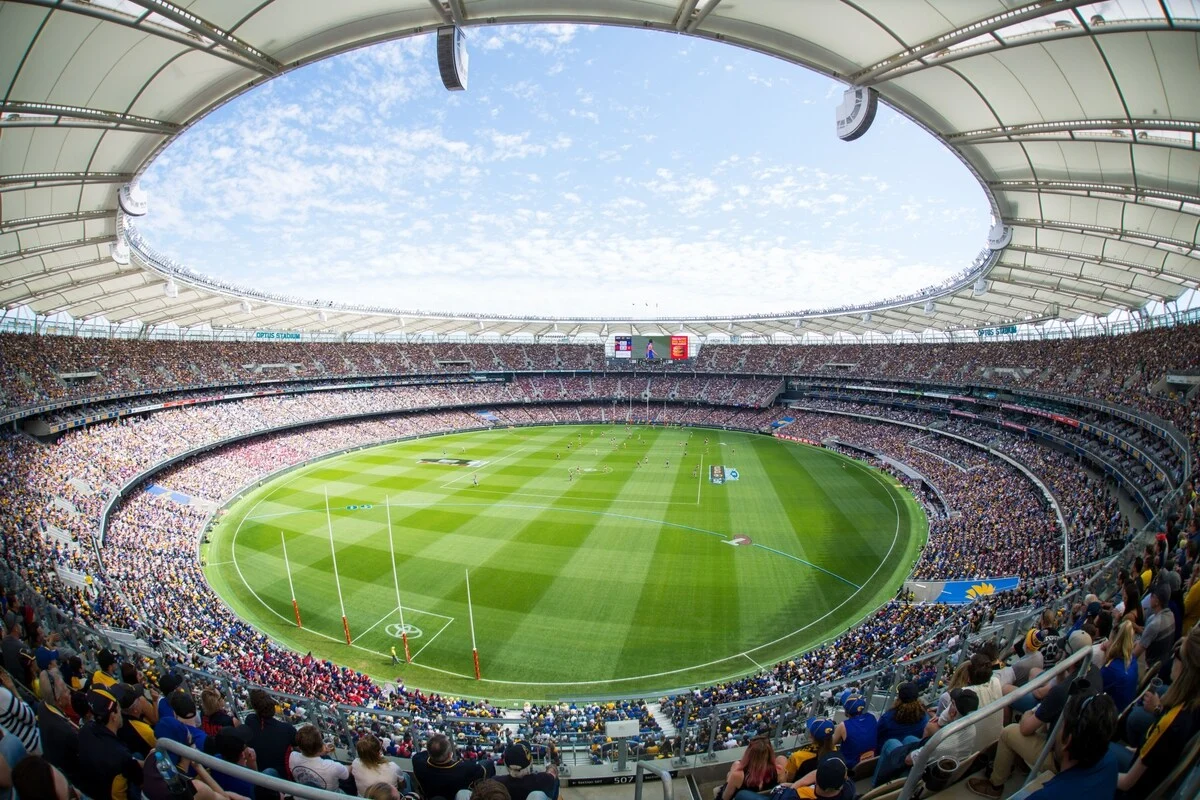
Fremantle's training and administration facilities are in Cockburn Central. West Coast's contact address is Mineral Resources Park in Lathlain. These are separate club locations from each other and from Optus Stadium. Searching for “Fremantle football ground” without specifying the men's AFL fixture could therefore send a visitor towards a different part of the metropolitan area.
This is also why club geography should not become a rule about supporters. A person staying near Fremantle can attend West Coast at Optus; an Eagles supporter can live anywhere. Use the locality to understand the name and the venue to organise the visit. Neither a hotel address nor a stadium address chooses a club allegiance for you.
A home fixture can take a club beyond its usual city
The club map is relatively stable; the match map spreads farther. A designated home team can host outside its principal city, so searching only that city's stadiums misses legitimate home fixtures. The released 2027 schedule provides several concrete examples. These allocations belong to that season and should not be treated as permanent guarantees for later years.
The GIANTS have eight designated home games at ENGIE Stadium in Sydney and three at Corroboree Group Oval Manuka in Canberra. Their Canberra opponents are West Coast in Round 2, the Western Bulldogs in Round 6 and Port Adelaide in Round 15. For an ACT-based supporter, those are nearby opportunities to see the same club listed under Greater Western Sydney. They do not create a separate Canberra team to add to the eighteen.
Hawthorn's 2027 home allocation includes four games at UTAS Stadium in Launceston, alongside six at the MCG and one at Marvel Stadium. That makes a Hawks home fixture a potentially interstate trip even for a Melbourne-based supporter. Launceston and Hobart should also remain distinct destinations: a reference to “Tasmania” is not enough to choose an airport, hotel or ground.
The Western Bulldogs offer a regional Victorian version of the same issue. Their two Mars Stadium games in Ballarat are against Gold Coast in Round 7 and the GIANTS in Round 20. A visitor following the Bulldogs from a Melbourne base must check whether that particular home game is at Marvel or in Ballarat. The club is unchanged; the journey is different.
Northern Territory fixtures extend the distinction further. The AFL's 2027 announcement places Melbourne versus Adelaide at TIO Traeger Park in Alice Springs in Round 7, and Gold Coast versus Carlton at TIO Stadium in Darwin in Round 10. The similar stadium branding does not put those matches in the same city. Nor does Gold Coast hosting in Darwin make it a Northern Territory-based club.
Gather Round creates another pattern: all eighteen clubs travel to South Australia for nine matches across Adelaide Oval, Norwood Oval and Barossa Park. A club's presence there describes an event allocation, rather than a relocation of its identity. For an occasional visitor, this can broaden the choice of teams available during one trip; for a committed supporter, the exact ground remains essential.
Finally, separate a confirmed place from a confirmed time. At the 2027 fixture release, Rounds 17–24 had match-ups and venues allocated while dates and start times remained floating. A Round 20 Ballarat allocation can help identify the destination before it supports a precise overnight itinerary. Check the eventual event details before turning that geographical possibility into a fixed booking.
Nicknames and colours describe identity across different guernseys
A nickname helps connect a scoreboard abbreviation, a supporter conversation and a club badge. “Blues” means Carlton, “Cats” means Geelong and “Kangaroos” means North Melbourne within this AFL list. The bird names are distinct too: Adelaide's Crows, Collingwood's Magpies, Hawthorn's Hawks, West Coast's Eagles and Sydney's Swans. Knowing the animal without the club name is less useful when searching across other football competitions.
Colours provide another clue, although they are not unique identifiers. Carlton and Geelong both use navy blue and white. Red and blue appear across several clubs in different combinations and shades. The complete club name and badge therefore carry information that a broad colour description cannot. A navy scarf alone will not tell a newcomer which Victorian fixture its wearer is attending.
There is also a difference between a club palette and a particular guernsey. The 2026 AFL regulations provide for approved home, away and alternative uniforms. Adelaide's 2026 home-guernsey announcement, for example, described changes to the navy collar and armholes. Such details can change the appearance of a jumper while the team remains recognisably the Crows.
Gold Coast shows a broader evolution. Alongside its traditional red, gold and blue identity, pink has become an enduring part of its contemporary branding. The club's 2026 account of the pink programme explains that it began at Gather Round in 2025 and expanded beyond that event. Its leadership presents pink as a lasting brand colour. Treating a pink SUNS guernsey as an unrelated club, or dismissing it as a single novelty appearance, would miss that deliberate development.
Port Adelaide's nickname needs a competition label
Port Adelaide requires particular care because “Magpies” and “Power” belong to different contexts. The club's account of its 1995 AFL brand launch explains the adoption of Power and the addition of teal and silver to black and white. The playing identity entered AFL competition in 1997; the brand launch itself was not an earlier AFL debut.
Port's SANFL coverage still uses Magpies, while Collingwood is the Magpies club in the men's AFL table above. Always retain the competition label when following a Port result or buying into a club event. The name alone should not turn a SANFL fixture into an AFL fixture or add an extra club to the national competition.
The black-and-white Prison Bars guernsey adds a heritage dimension rather than erasing that distinction. Port's account describes its importance to the club's history and supporters. A heritage design can tell a deeper club story without changing the opponent listed on the match programme. For recognition, combine the badge, club name, competition and dated guernsey context.
Turn the club map into an actual match plan
Begin with the part of the trip you are committed to. If it is a club, start with that team's full fixture and then check the ground on each suitable date. If it is a city break, start with games physically taking place in that city, regardless of which club is designated home. If the attraction is a particular stadium, search that ground directly. These three starting points answer different questions.
Consider a supporter following the GIANTS. The GIANTS fixture page keeps their Sydney, Canberra and away matches together. A visitor already staying in Sydney can instead use the Sydney games page to compare the SCG and ENGIE Stadium. A Canberra home game belongs in the club's season but does not belong in a list of matches physically played in Sydney. Choosing the starting question prevents that mismatch.
A neutral visitor to Perth has a different opportunity: compare all Optus Stadium fixtures rather than picking a date from only the Eagles' or Dockers' schedule. The Perth city fixture also catches visiting clubs' designated home occasions. For someone whose aim is to experience the stadium, the ground and date may be more important than the host's usual state. For someone following a particular team, the opponent and home designation remain relevant.
Then read the clock label. Fremantle versus the Western Bulldogs at Optus Stadium on 18 March 2027 is scheduled for 5:10pm AWST in Perth, equivalent to 8:10pm AEDT in Melbourne. Those are two displays of the same first bounce. The example is checked against the official fixture's start time; it shows why an eastern-state display should not become an assumed local arrival time.
Once the match is selected, move from the club's name to the venue's own visitor information through the ground directory. This is the point to check the actual precinct, entrance arrangements and transport guidance. A team headquarters address, a historical ground or a similarly named stadium is useful background, but none substitutes for the venue printed on that event's listing.
Keep the final booking record specific: men's AFL, the two clubs, the designated host, the named ground, and the confirmed local date and first bounce. Check ticket availability separately from the fixture. A calendar listing tells you where a club is scheduled to play; it does not reserve a seat. With those details together, the state, city and nickname become useful orientation for a real match-day plan.
Join the conversation
Share a question or a thought about AFL. Comments are reviewed before they appear. Keep it friendly and on topic.
No comments yet. Start the conversation.
Sign in with Google to leave a comment. Your email address is not displayed.