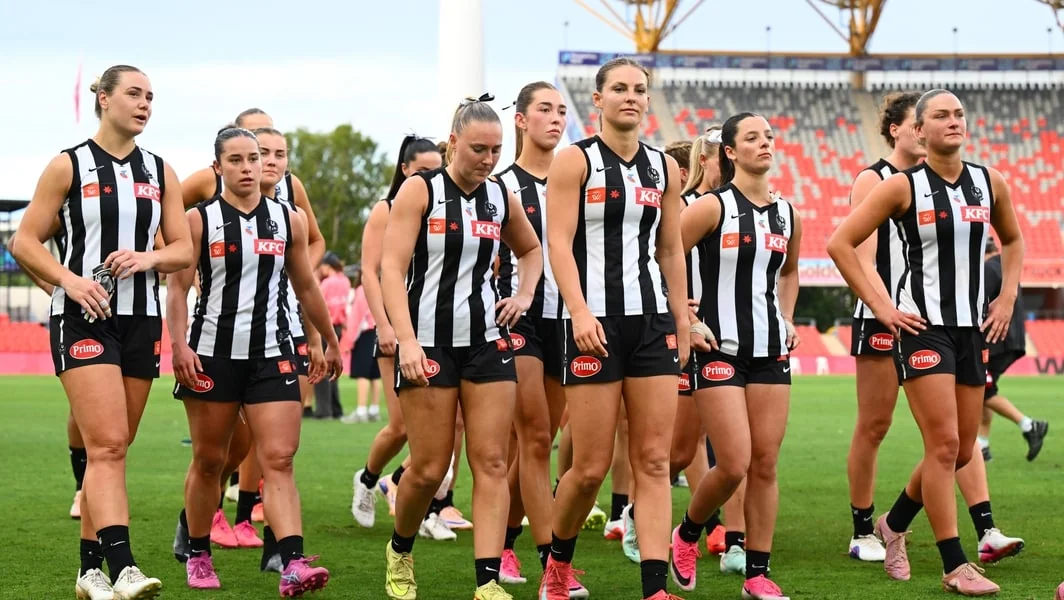
Collingwood's 2026 AFLW season ended with one win, 11 losses and a 17th-place finish. It also ended with major changes: captain Ruby Schleicher had announced her return to Western Australia, Sam Wright was leaving the senior coaching role and Sabrina Frederick was retiring. Those developments make an August squad preview an incomplete guide to the team by November.
This review brings the season's player directory, leadership announcements and final results together. The squad table records who appeared in the club's 2026 directory, including an inactive player and her replacement; it is not a selected match team or a confirmed list for 2027. The distinction matters when following the younger players' development, assessing the gaps left by departures and reading the club's plans after a difficult campaign.
Read Collingwood's 2026 season as a completed campaign
Collingwood finished the 2026 AFLW home-and-away season seventeenth, with one win and eleven losses from twelve matches. This is a guide to that women's campaign and its players, rather than the men's 2027 fixture. The shared club name does not make the teams, schedules or player lists interchangeable.
The official 2026 AFLW ladder records four premiership points, 350 football points scored and 646 conceded. That produces a percentage of 54.2 and a scoring deficit of 296. The low position was therefore accompanied by a substantial gap on the scoreboard across the season, rather than being decided by a narrow tie-break at the finals boundary.
Date the record carefully. Reports published before the last round described a one-win, ten-loss season because one match remained. Collingwood then lost its final game to Essendon, 38–31 at Windy Hill on 1 November. The completed record is one and eleven. Leaving out that final result would turn a contemporary news snapshot into an inaccurate season summary.
The end of the campaign also changed how the leadership information should be presented. A season guide can accurately identify the captain and coach who began the year while still recognising that the program had reached a point of transition by November. Those are dated roles, not a promise about who will hold them when the next team runs out.
For the players, the season's overall result and an individual's contribution need separate attention. A rebuilding squad can contain experienced leaders, new recruits and developing footballers whose performances differ markedly within the same losing team. The useful approach is to identify the player and her role, then connect any assessment to a selected side, an actual match or a named award.
The information below was checked on 15 November 2026. The squad table preserves the names and numbers displayed in Collingwood's official AFLW directory for this campaign. Later retirement and departure announcements are explained alongside it, so that a historical list remains useful without becoming an unsupported list of guaranteed players for the following season.
The 2026 players and the roles to recognise
The official club directory displays the following thirty-three names and jumper numbers. It includes Matilda Argus, who was unavailable for the season, and injury replacement Dominique Carbone. This is a directory snapshot associated with the campaign, rather than a claim that thirty-three footballers were simultaneously available for selection.
The formal names also help connect familiar references in match reports: Ashley Centra is usually called Ash, Brianna Davey is Bri, Lucille Cronin is Lucy and Josephine Bamford is Josie. Keep the number beside the name when looking through footage or team announcements, especially with several new players joining the program.
| No. | Player | Directory role |
|---|---|---|
| 1 | Sabrina Frederick | Ruck |
| 2 | Eliza James | Forward |
| 3 | Brianna Davey | Midfielder |
| 4 | Imogen Barnett | Key Forward |
| 5 | Maisie Nankivell | Key Defender |
| 6 | Jordyn Allen | Defender |
| 7 | Sarah Rowe | Defender |
| 8 | Brittany Bonnici | Midfielder |
| 9 | Mischa Barwin | Forward |
| 10 | Matilda Argus | Midfielder |
| 11 | Ariana Hetherington | Key Defender |
| 12 | Georgia Knight | Forward |
| 14 | Mattea Breed | Midfielder |
| 16 | Ashley Centra | Midfielder |
| 17 | Dominique Carbone | Midfielder |
| 18 | Ruby Schleicher | Forward |
| 19 | Ellie Brady | Forward |
| 20 | Charlotte Brewer | Defender |
| 21 | Amber Schutte | Defender |
| 22 | Imogen Trengove | Forward |
| 23 | Lauren Butler | Defender |
| 24 | Kellyann Hogan | Midfielder |
| 25 | Zara Neuwirth | Key Defender |
| 26 | Violet Patterson | Defender |
| 27 | Lucille Cronin | Midfielder |
| 28 | Amy Smith | Midfielder |
| 29 | Tarni White | Defender |
| 30 | Carly Remmos | Midfielder |
| 33 | Olivia Lewis | Key Forward |
| 35 | Kalinda Howarth | Defender |
| 36 | Airlie Runnalls | Midfielder |
| 37 | Josephine Bamford | Ruck |
| 43 | Jemma Rigoni | Defender |
Keep the season squad separate from the selected team
A directory entry is not confirmation that a player took part in a particular game. The club's pre-season explanation identified Argus as unavailable following a knee injury and Carbone as an injury replacement. An October update then ruled Carbone out for the rest of the season. Both names remaining online does not reverse those announcements.
The last-round selection provides another useful distinction: Mattea Breed was managed and Kalinda Howarth was omitted. Those were different stated reasons for leaving the team. A supporter should retain that wording rather than treating every absent player as injured or assuming an omission settles her future at the club.
Position labels are similarly a starting point. The directory identifies rucks, key-position players, midfielders, forwards and defenders; it does not publish a permanent match formation. For a specific contest, the selected team and the match itself show which combinations were used. That matters when judging a player's contribution: a broad profile label cannot explain every assignment she carried out.
Put the newcomers in their proper context
Collingwood's season introduction described thirteen arrivals and eleven departures, with two extra list places granted for 2026 and 2027. The additions came through several routes: Ariana Hetherington from North Melbourne, Jemma Rigoni from Melbourne, Charlotte Brewer, cross-code recruits and six draft selections. New to Collingwood did not necessarily mean new to senior football.
The different backgrounds are worth recognising. Ellie Brady arrived from Gaelic football, while Maisie Nankivell and Olivia Lewis came from Super Netball. The draft intake included Imogen Trengove, Amy Smith, Mischa Barwin, Josie Bamford, Argus and Zara Neuwirth. They were entering a list that also contained established names, rather than replacing its entire experience base.
Brady's debut announcement shows the pathway in practical terms. The Cavan recruit had kicked two goals in five VFLW appearances before being named against Essendon, becoming Collingwood's thirteenth club debutant of 2026. Her earlier connection with former Pie Aishling Sheridan is background to that recruitment, not evidence that Sheridan was on this season's list.
Centra belongs in a different category again. Her club profile identifies her as the first pick in the 2024 AFLW draft. She was a developing second-year player in 2026, rather than one of that year's new arrivals. Separating those stages gives a clearer picture of where experience and development sat within the same squad.
Captain and coach: the season roles and the departures
Collingwood's 2026 leadership announcement named Ruby Schleicher as captain, Jordyn Allen as vice-captain and Lucy Cronin as the third member of the group. Schleicher was entering her second year in the captaincy, Allen her third as vice-captain, and Cronin her first official leadership role.
Those appointments describe how the side entered the campaign. They should remain attached to 2026 when discussing its history. By the end of October, separate announcements about the captain and senior coach meant a season guide could no longer simply repeat the pre-season roles in the future tense.
Ruby Schleicher's captaincy and return-home decision
On 20 October, the club confirmed Schleicher's decision to leave at season's end and return to Perth to be closer to family while continuing her football career. She had been part of the program from its inaugural 2017 season, earned two All-Australian selections and won Collingwood's 2024 best and fairest before becoming captain in 2025.
A confirmed departure decision and a completed move to a named rival are different stages. Reporting linked Schleicher with West Coast, but the club's announcement established her return-home decision rather than a finalised trade destination. Retaining that distinction respects what was actually confirmed and avoids assigning a new club from an anticipated deal.
Her absence late in the season also needs a separate explanation. The club's Round 10 health update said a right-shoulder fracture sustained against St Kilda had ruled her out for the remainder of the campaign. That statement explains the season-ending absence; it does not provide a recovery date for the next season.
Sam Wright's final season in charge
Sam Wright coached Collingwood in 2026, his third season leading the AFLW program. The club's October notice confirmed that he would step down, with the Round 12 game against Essendon at Windy Hill his final match as senior coach. That fixture has since been played.
The accurate historical answer to who coached the 2026 side is therefore Wright. Presenting him as continuing into the following campaign would ignore the later announcement. His successor needs a separate appointment confirmation; an old contract reference or a discussion of possible candidates is not that confirmation.
The same care applies to the next captain. Allen's vice-captaincy and Cronin's elevation show established leadership responsibility within the 2026 group. Neither appointment automatically names a replacement for Schleicher. For supporters following the transition, the meaningful next information is the club's actual leadership decision, alongside the coaching and football-program changes.
What the results and individual recognition show
Collingwood's only victory came in Round 7, beating GWS 34–25 at Victoria Park on 27 September. Six defeats preceded that win and five followed it. The official season records below account for all twelve matches, rather than selecting only the most competitive finishes.
| Round | Date | Opponent | Collingwood | Opponent score | Ground |
|---|---|---|---|---|---|
| 1 | 15 August | Richmond | 4.4 (28) | 6.10 (46) | IKON Park |
| 2 | 23 August | Fremantle | 4.6 (30) | 8.2 (50) | Victoria Park |
| 3 | 30 August | Hawthorn | 3.8 (26) | 8.6 (54) | Victoria Park |
| 4 | 6 September | Carlton | 4.5 (29) | 10.8 (68) | IKON Park |
| 5 | 12 September | Gold Coast SUNS | 4.8 (32) | 9.8 (62) | People First Stadium |
| 6 | 19 September | Geelong Cats | 7.7 (49) | 14.6 (90) | Victoria Park |
| 7 | 27 September | GWS GIANTS | 4.10 (34) | 3.7 (25) | Victoria Park |
| 8 | 4 October | Melbourne | 2.9 (21) | 6.6 (42) | Victoria Park |
| 9 | 10 October | St Kilda | 5.7 (37) | 5.9 (39) | RSEA Park |
| 10 | 18 October | Sydney Swans | 4.5 (29) | 12.8 (80) | Windy Hill |
| 11 | 23 October | Port Adelaide | 0.4 (4) | 8.4 (52) | Alberton Oval |
| 12 | 1 November | Essendon | 4.7 (31) | 4.14 (38) | Windy Hill |
The narrow losses to St Kilda, by two points, and Essendon, by seven, were real opportunities to change the record. But the other nine defeats were all by at least eighteen points. Describing the entire season as a series of unlucky close finishes would therefore misrepresent the results. The pattern included both near misses and substantial scoring gaps.
The highest Collingwood total was 49 against Geelong, a game still lost by 41. The lowest was four points in the goalless loss at Alberton. Those two results show why a single attacking high point cannot stand in for sustained competitiveness. A side needs scoring production and the ability to contain its opponent in the same contest.
Find the positives without disguising the results
Tarni White's 2026 All-Australian squad selection is one concrete individual achievement. The club reported an average of 21.8 disposals, with twenty-nine disposals and fourteen intercepts against Gold Coast among her standout performances. Squad selection is the recognition confirmed by that announcement; it should not be rewritten as selection in the final All-Australian team.
Ash Centra and Lucy Cronin were also named in the extended 22Under22 squad. That provides a specific basis for discussing emerging talent within a difficult team season. It is another squad announcement, with a separate final-team selection process, rather than proof that the whole program's problems had already been solved.
The final-round report adds match-level evidence: Centra had twenty-five disposals, seven clearances and a goal, while Brady and Trengove kicked their first AFLW goals. Those contributions can be recognised alongside the defeat. They make the player discussion more useful than either dismissing everyone because of the ladder position or treating development as a substitute for winning.
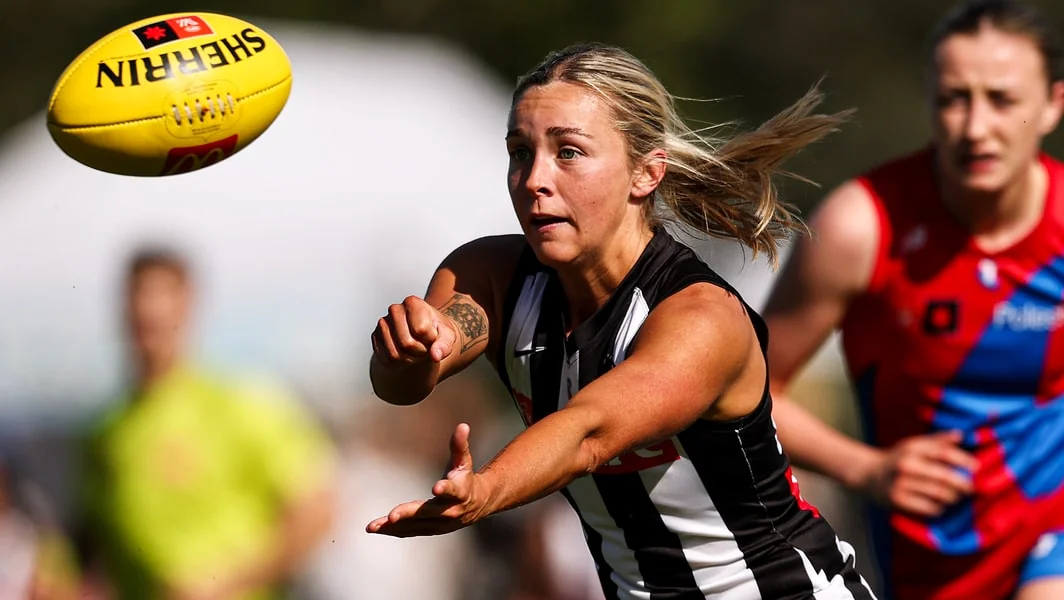
For a supporter choosing players to follow, that leaves several different questions. White's recognition concerns established performance; Centra and Cronin provide evidence of developing influence; a debut goal marks the beginning of a senior pathway. None is the same as a prediction of the next season's ladder. Each is a grounded reason to keep watching a particular player's progress.
What is settled, and what the next announcements must answer
Collingwood's official AFLW update commits the club to a strategic review involving an independent external expert and its AFLW Subcommittee. The club acknowledges that its program has underperformed and promises another update with recommendations and priorities when that work is complete. That establishes a process and responsibility for improvement. It does not publish the review's conclusions, identify a single cause of the losses or prove that a particular staffing change will solve the problems.
One playing change is already definite: Sabrina Frederick announced her retirement before the final match. Her inclusion in the season directory above is therefore a historical record, rather than a promise that she will lead the ruck again next year. Frederick's progression from a forward to Collingwood's leading ruck makes her departure relevant to how the side will move the ball out of stoppages. Recruiting a replacement, developing another listed player and changing the ruck combination are different possibilities; the retirement announcement does not choose between them.
Retention news also needs careful reading. In Riley Beveridge's AFL.com.au report on 11 November, Centra and Cronin were already contracted for 2027 and were close to agreeing longer extensions. That is encouraging reporting about negotiations, not an official announcement that the additional years have been signed. It also differs from a player merely being pictured in club colours on a profile page. Supporters assessing the rebuild should look for the actual contract announcement and its stated duration before treating the proposed extensions as completed business.
The leadership decisions are separate again. An appointment of the next senior coach would establish who is responsible for preparing and selecting the team after Wright. A new captaincy announcement would establish the continuing leadership arrangement after Schleicher's departure. Neither role should be filled in a season guide by assumption: being a vice-captain or taking charge for an injured teammate does not itself announce the following year's captain. Similarly, recognition in an extended awards squad does not settle a player's future club or positional role.
For the next match announcement, use the official AFLW fixture and check the selected season and Collingwood filter. Women's fixtures, player announcements and match selections are the relevant updates to this review. The men's fixture list cannot establish when these players next take the field. Until the new appointments, list decisions and schedule are confirmed, the useful starting point remains the completed 2026 campaign: the players who were part of it, the roles they held then and the results they actually recorded.
Join the conversation
Share a question or a thought about AFL. Comments are reviewed before they appear. Keep it friendly and on topic.
No comments yet. Start the conversation.
Sign in with Google to leave a comment. Your email address is not displayed.