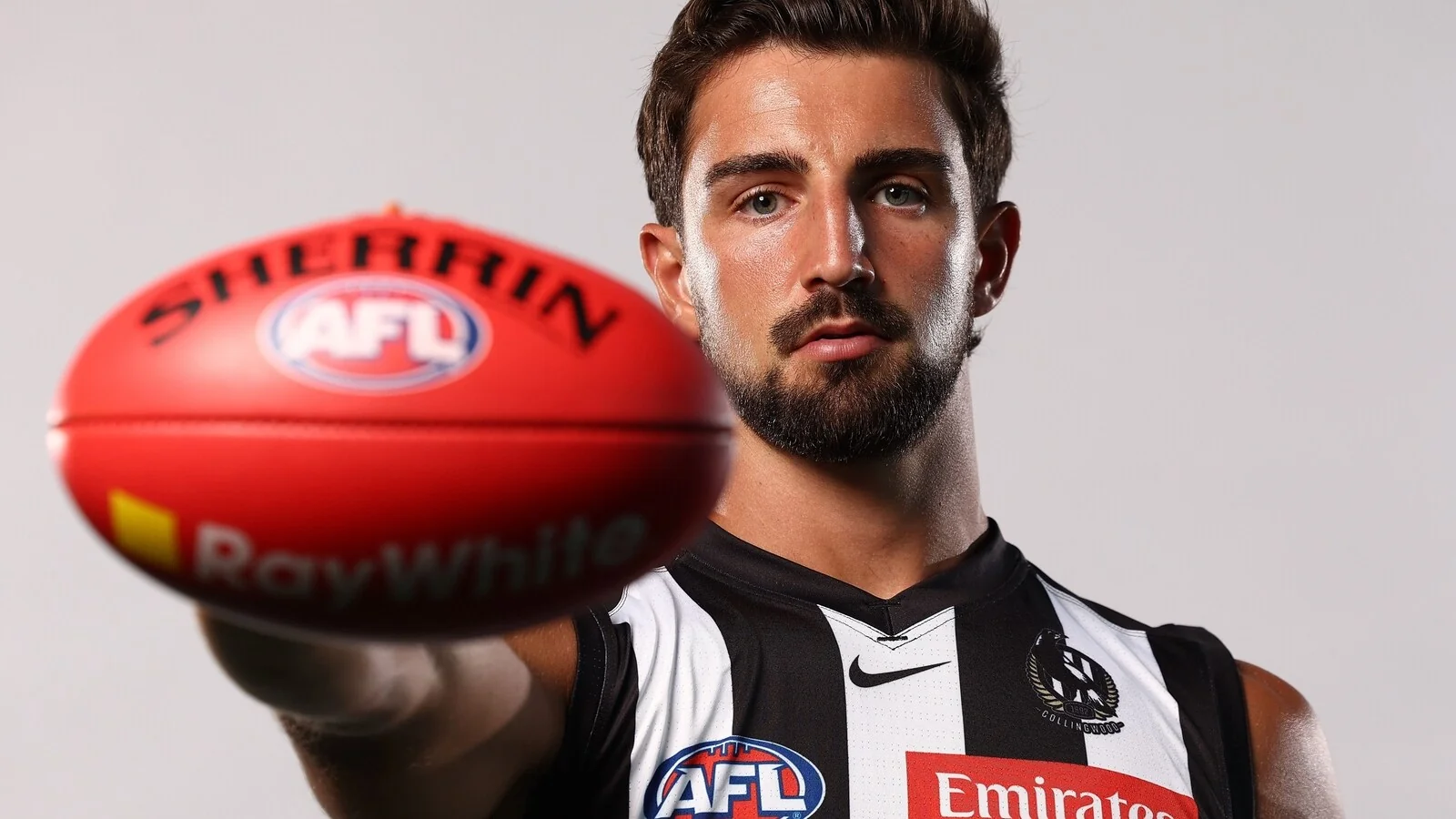
Looking for a Collingwood player's number? This guide brings together the complete official men's 2026 squad, the number changes that can make identification confusing, and confirmed player movements for 2027. The season register stays separate from the next list, so an older match and a new signing each have the right context.
The complete Collingwood men's squad for 2026
The following table records all 46 players in Collingwood's official men's 2026 season directory. It includes the late additions and preserves each player's number and the club's listed position. The official squad page explicitly identifies this as the 2026 Toyota AFL Premiership Season list and says the 2027 version will follow the off-season player movement period.
That season label is essential when revisiting a match or identifying a player in an older photograph. Number 10 refers to Scott Pendlebury in this record; numbers 40 and 48 identify Noah Howes and Harrison Coe. Those associations belong to the season shown. A different year's directory answers a different question, so a search result without its season can be misleading even when the name and number were once correct.
| 2026 number | Player | Club's listed position |
|---|---|---|
| 1 | Patrick Lipinski | Midfielder |
| 2 | Jordan De Goey | Midfielder |
| 3 | Isaac Quaynor | Defender |
| 4 | Brayden Maynard | Defender |
| 5 | Jamie Elliott | Forward |
| 7 | Josh Daicos | Defender |
| 8 | Lachie Schultz | Forward |
| 9 | Dan Houston | Defender |
| 10 | Scott Pendlebury | Midfielder |
| 11 | Daniel McStay | Key Forward |
| 12 | Harry Perryman | Defender |
| 13 | Harry DeMattia | Midfielder |
| 14 | Darcy Cameron | Ruck |
| 15 | Wil Parker | Defender |
| 16 | Edward Allan | Midfielder |
| 17 | Billy Frampton | Key Defender |
| 18 | Tyan Prindable | Midfielder |
| 19 | Tew Jiath | Defender |
| 20 | Iliro Smit | Ruck |
| 21 | Oscar Steene | Ruck |
| 22 | Steele Sidebottom | Midfielder |
| 23 | Bobby Hill | Forward |
| 24 | Jakob Ryan | Defender |
| 25 | Jack Crisp | Midfielder |
| 26 | Reef McInnes | Key Defender |
| 27 | Joel Cochran | Key Defender |
| 28 | Tim Membrey | Key Forward |
| 29 | Charlie West | Key Forward |
| 30 | Darcy Moore | Key Defender |
| 31 | Beau McCreery | Forward |
| 32 | Sam Swadling | Midfielder |
| 33 | Lachlan Sullivan | Forward |
| 34 | Jack Buller | Key Forward |
| 35 | Nick Daicos | Midfielder |
| 36 | Harvey Harrison | Forward |
| 37 | Zac McCarthy | Key Forward |
| 38 | Jeremy Howe | Key Defender |
| 39 | William Hayes | Forward |
| 40 | Noah Howes | Key Defender |
| 41 | Angus Anderson | Forward |
| 43 | Jai Saxena | Forward |
| 44 | Ned Long | Midfielder |
| 45 | Roan Steele | Midfielder |
| 46 | Mitch Podhajski | Key Forward |
| 47 | Liam Puncher | Key Defender |
| 48 | Harrison Coe | Ruck |
Numbers 6 and 42 have no player attached in this official snapshot. The gaps do not establish a reason for the vacancy or an assignment for a future recruit. Nor does the run through number 48 imply a 48-player squad: the two gaps leave 46 named entries. For a quick identification, match the number and name together rather than assuming the numbering is continuous.
Position labels need a similar degree of care. The club lists Josh Daicos as a defender and Reef McInnes as a key defender; these are the directory labels reproduced here. A supporter remembering a player's earlier role should not silently substitute it into a current season reference. Equally, the label does not describe every task that player performs during a match. A defender can help launch an attack, and a forward can spend important time applying pressure without being the final target.
Finally, this is a squad register rather than a weekly selection. Inclusion does not prove an AFL appearance, availability for a particular round or a place in the next senior team. The distinction is especially useful for recruits whose first football at the club came in the VFL. Use the full directory to identify the player; use the relevant match team to establish who actually played.
The number changes that matter when identifying players
A Collingwood guernsey can carry a familiar number without carrying the familiar player. The distinction is useful when looking at highlights, buying a numbered jumper or explaining the team to somebody beginning to follow the club. Start with the season and the name, then use the number to confirm the identification.
New arrivals took over familiar guernseys
The club's number announcement ahead of 2026 assigned 18 to Tyan Prindable, 32 to Sam Swadling, 34 to Jack Buller, 37 to Zac McCarthy, 41 to Angus Anderson and 43 to Jai Saxena. Noah Howes moved from 47 to 40. These are 2026 assignments, even though the announcement came after the previous year's trade and draft period.
Two changes make the identification problem especially clear. Swadling took over 32 after Will Hoskin-Elliott's retirement, while Anderson received 41 after Brody Mihocek moved to Melbourne. A supporter recognising the old number still needs to recognise the new occupant. McCarthy's 37 also has an association with Brayden Maynard, but Maynard is number 4 in the 2026 register.
The association with an established player can make a number memorable; it cannot tell you how its new owner will play. Anderson should be assessed on his own football, not asked to reproduce Mihocek's role because they share a number. The same applies to Swadling. Separating identity from expectation lets a new player develop without every possession becoming a comparison with a predecessor.
Mid-season additions belong in the season record
Collingwood's 2026 mid-season recruiting announcement brought in Harrison Coe from Frankston, Liam Puncher from Woodville-West Torrens and Mitch Podhajski from Coburg. The season directory places Coe in 48, Puncher in 47 and Podhajski in 46. An early-season list can therefore be genuine and still be incomplete as a reference for the whole year.
These were targeted additions across three different lines. In his Round 12 media conference, Craig McRae connected the ruck, forward and key-defender recruits with the absences of Oscar Steene, Jamie Elliott and Reef McInnes. That explains the recruiting logic at the time. It does not establish those players' medical status months later or guarantee that each recruit would immediately play senior football.
Number 47 is a useful practical example: it identifies Howes in his first season at the club and Puncher in this 2026 table. A number-only search can mix the two. Pairing the name with the year resolves the apparent contradiction, while the recruiting announcement explains why a new player appears after the season has begun.
Read the squad by football role, not just number
The number table becomes more useful when it helps you recognise what a player contributes. Collingwood's midfielders do not all win the ball in the same circumstances, its defenders do not all take the same opponent, and its forwards have responsibilities beyond the final shot. These differences explain why replacing a name on a list is rarely a simple one-for-one exercise.
The midfield has ball winners and different outside roles
Nick Daicos, number 35, is an established midfield player rather than simply a defender collecting possessions behind the ball. The club's 2026 season assessment before the Copeland Trophy records averages of 34.7 disposals and a goal. Jordan De Goey, number 2, averaged 21.4 disposals and a goal. Those figures describe different volumes of involvement; they do not establish that both players do an identical job or that every disposal has the same value.
De Goey's club profile emphasises his explosive game. Ned Long's profile instead highlights a strong body, tackling and pressure. When watching the midfield, look at who wins the initial contest, who offers the next release and who prevents the opposition breaking away. An attacking possession and a defensive effort can both help the same passage, even when only one produces a prominent statistic.
Jack Crisp, number 25, adds another distinction: the club describes a left-footer capable of playing several positions. Josh Daicos, number 7, illustrates why a directory label is only a starting point. The squad table lists him as a defender, while his profile describes his wing and midfield contribution. Preserve both pieces of context rather than forcing his football into one box. Watch his starting position and his involvement as the ball moves; the number identifies the player, while the passage shows the task.
Defence combines marking, distribution and pressure
Darcy Moore in 30, Jeremy Howe in 38 and Billy Frampton in 17 sit among the key defenders in the season register. That grouping does not make them interchangeable. A supporter assessing a defensive passage should distinguish the player contesting the incoming ball, the teammate covering another target and the player offering an outlet once possession changes. A mark is the visible finish to a situation that may involve several defenders.
Dan Houston's profile identifies half-back play and a powerful right foot. That makes distribution a useful part of watching number 9: where is the next option, and does the kick help Collingwood advance or merely move the ball sideways? Good ball use still depends on teammates creating a viable option. It is unhelpful to attribute an entire successful transition to the player making its last kick.
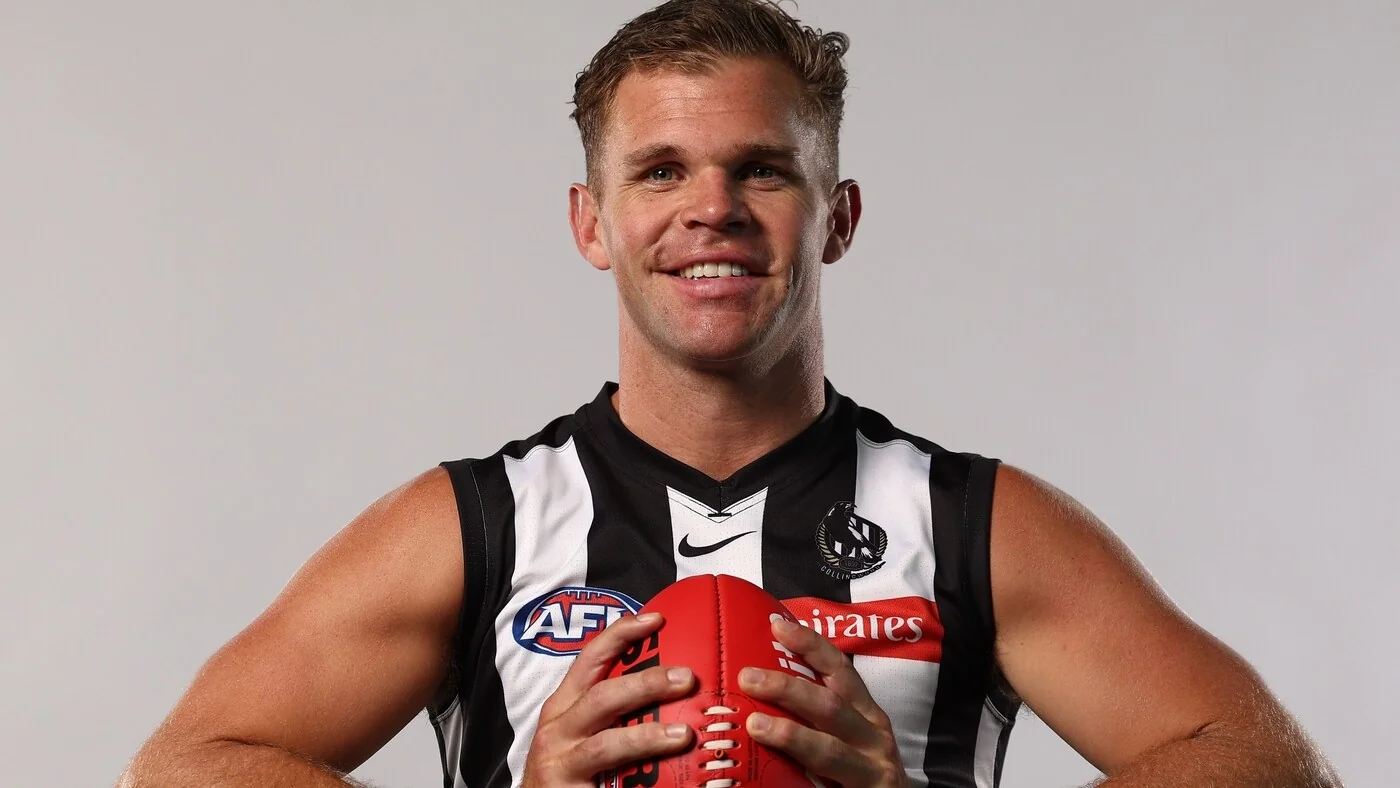
Brayden Maynard in 4 and Isaac Quaynor in 3 offer further points of identification in the back half. The club's season assessment singles out Quaynor and Frampton's work, which is a reminder to look beyond the most recognisable names. For any defender, assess the difficulty of the opponent and the help available as well as the final outcome. Losing one contest cannot, by itself, explain whether the defensive structure worked.
Forwards and rucks give the attack different options
Daniel McStay in 11 is a key-forward reference point, with his profile stressing marking and goal-kicking. Tim Membrey in 28 supplies another established scoring option. When identifying a tall forward, watch the lead and the contest before judging the possession total. Presenting a target can affect where the defence moves even when that player does not finish with the ball.
Beau McCreery in 31 supplies a different lens. His pressure-forward profile highlights speed, making the chase after a turnover part of his contribution. The useful comparison is not simply whether he takes as many marks as McStay. It is whether the forward group has the mix of targets, ground-level work and pressure needed to keep an attack alive and respond when possession is lost.
Darcy Cameron, number 14, connects the lines through the ruck. His work should be considered alongside the midfield's response, not reduced to whether a hand touches the ball first. A tap needs a teammate able to use it; an unsuccessful clearance does not automatically mean the ruck contest was lost. The other rucks in the 2026 directory also represent development and coverage options, rather than proof they all shared the same senior role. Identifying those different jobs makes the full squad more informative than a list of familiar stars.
What is confirmed for Collingwood's 2027 list
The 2026 register and the next season's player movements answer different questions. As of 15 November 2026, the club has confirmed the following changes, while further draft decisions remain ahead. The tables preserve historical numbers for departing players and leave incoming players' new Collingwood numbers unassigned.
Neale, Hogan and Riley change the available options
The club's completed trade and free-agency wrap confirms Lachie Neale from Brisbane, Jesse Hogan from Greater Western Sydney and Flynn Riley from Carlton. A later announcement adds Irish recruit Finnbarr Roarty. Reading only the trade-period summary would miss that fourth arrival.
| Confirmed arrival | Route | Football context |
|---|---|---|
| Lachie Neale | Unrestricted free agent, Brisbane | Experienced midfielder |
| Jesse Hogan | Trade, GWS | Experienced key forward |
| Flynn Riley | Trade, Carlton | Developing ruck |
| Finnbarr Roarty | Category B rookie signing | Gaelic football recruit; AFL role to develop |
Neale brings established midfield experience to a group containing Nick Daicos and developing players such as Edward Allan and Sam Swadling. That can give the younger players another experienced teammate to learn from. It still leaves a football question for the coaches: how should the midfield's attacking work, defensive responsibilities and time around the contest fit together? Adding a prominent name does not answer the combination question on its own.
Hogan creates a different choice in attack alongside McStay, Membrey and Schultz. More marking options can change which opponent a forward draws and where the team chooses to send the ball. The value depends on how the targets and the ground-level players work together. It would be premature to turn an arrival announcement into a fixed forward line or a promise that every established player will have the same role.
Riley and Roarty also need different expectations from the experienced recruits. Riley has already appeared at AFL level for Carlton, but remains a young ruck developing his game. The club's Roarty introduction says his position will be worked through during his first AFL pre-season. His Gaelic football background offers athletic and football skills to develop; it does not establish a ready-made AFL position or an immediate senior debut.
Departures and the DeMattia rookie commitment need separate labels
The changes are broader than the high-profile arrivals. The 1 September club announcement confirmed six players would not receive contracts for 2027. Further decisions followed, alongside a retirement and a trade. This is the confirmed status of the following names from the 2026 table:
| 2026 number | Player | Confirmed change |
|---|---|---|
| 10 | Scott Pendlebury | Traded to Gold Coast |
| 13 | Harry DeMattia | Delisted; club committed to rookie re-selection |
| 15 | Wil Parker | Not offered a 2027 contract |
| 20 | Iliro Smit | Not offered a 2027 contract |
| 22 | Steele Sidebottom | Retired from AFL football |
| 23 | Bobby Hill | Club and player mutually parted ways |
| 24 | Jakob Ryan | Not offered a 2027 contract |
| 27 | Joel Cochran | Not offered a 2027 contract |
| 33 | Lachlan Sullivan | Not offered a 2027 contract |
| 40 | Noah Howes | No new contract; club open to draft consideration |
| 46 | Mitch Podhajski | Not offered a 2027 contract |
| 48 | Harrison Coe | Not offered a new contract |
Pendlebury's move to Gold Coast is a completed trade, not a retirement. Sidebottom called time on his playing career at the end of Collingwood's campaign. Those are two distinct changes to the experienced midfield group. Neale's arrival adds experience, but it does not make the combination identical to the one supporters watched in 2026.
Hill's status also illustrates why an older contract announcement cannot settle a current list question. The club and player confirmed a mutual departure. His presence in the season directory records his association with the 2026 squad; it is not evidence that the earlier contract announcement still describes the next season's list.
The 21 October update makes another distinction. DeMattia was delisted with an explicit commitment to re-select him in the Rookie Draft. For Howes, the club said it remained open to considering him in the national or rookie drafts. A commitment to re-draft and an openness to consideration are different statements; neither should be rewritten as a selection already completed.
That same update confirmed Jai Saxena's one-year deal for 2027 after a VFL season of 17 games and 24 goals. Retention matters alongside recruitment: it gives a developing player another period in the program. Assess the emerging squad through those individual decisions, rather than simply subtracting every departing name from the old table and declaring the remaining number a final list size.
Use the right list when the next season begins
There are three useful questions to keep separate. Who wore a number in 2026? Which player movements have been confirmed since then? Who has been selected for the particular game you are about to watch? The historical table, the dated movement announcements and the match team answer those questions in turn. Treating one as a substitute for the others creates avoidable confusion.
The official squad page's season notice is especially helpful during this transition. A completed recruit can be absent from the displayed 2026 directory because that directory has not yet become the 2027 version. Conversely, a familiar player can remain in the season register after a departure announcement. Read the page's scope before treating either situation as new player-movement news.
For an incoming player's number, wait for the club's actual assignment. A number worn at Brisbane, GWS or Carlton does not automatically transfer to Collingwood, and an apparent vacancy does not reserve the guernsey for a particular recruit. The previous assignment announcement shows why this matters: both new players and an existing player changing numbers can affect the reference supporters use.
Then follow the football through the Collingwood fixture page, which organises upcoming opponents, venues, times and viewing details. Check the selected team when the game approaches rather than expecting that fixture page to establish the playing list. A listed player, an available player and a selected player are different things.
The most informative watchlist is organised by role as well as reputation. Look at how Neale fits with the midfield group, how the forward options combine and where Riley or Roarty can develop their games. Those questions give the new season context without declaring every recruit an immediate starter. Keep the 2026 number register as a reliable record of identities, then let the club's subsequent announcements and actual team selections establish the next chapter.
Join the conversation
Share a question or a thought about AFL. Comments are reviewed before they appear. Keep it friendly and on topic.
No comments yet. Start the conversation.
Sign in with Google to leave a comment. Your email address is not displayed.